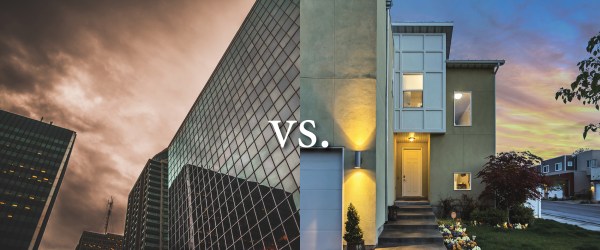
Commercial vs. Residential Real Estate

Benefits and Risks of Investing in Commercial and Residential Real Estate

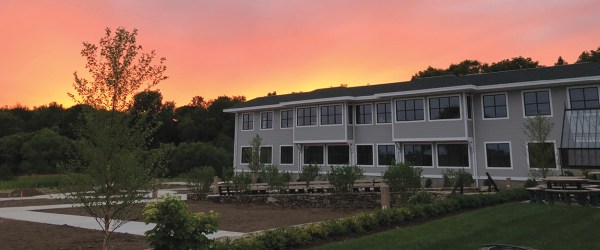
As real estate developers, we take into account differences with commercial and residential real estate when building or renovating. With 350 Goose Lane Office Park development, we work to develop commercial office space that can be built-to-suit, while incorporating top of the line features and plenty of green space. At The Residences at 66 High Street, we focus on luxurious amenities and convenience for residents. Differences between commercial and residential do not stop with the development – there is also a lot to consider as an investor. We outline some of the key benefits and risks below.

Commercial Properties – Potential Benefits & Risks

If you have the funding and experience, there are a handful of potential benefits to investing in a commercial property.

  • Longer leases, generally ranging between 3-10 years, provide more stable income.
  • Less maintenance for the owner, developer, or property manager, assuming net lease agreements are in place.
  • Strong returns in the form of income and capital growth.

Commercial real estate ventures also come with potential downsides. Because commercial properties are pricier than most residential properties, they often require higher start-up costs. Also, finding tenants for open space can be difficult, particularly in a poor economy.

Residential Properties – Potential Benefits & Risk

Whether flipping houses or investing in large multi-family properties, residential real estate can be a great investment medium for individuals from all income brackets. The potential benefits include:

  • Lower start-up costs, whether you are buying a one family or multi-family property.
  • Easier to finance, with mortgage options for every type of buyer.
  • Tenants found faster, compared to commercial tenants.

While one can flip a house and put it right back on the market, being an investor or landlord in a residential property requires a great deal of involvement. In regards to property management, residential buildings require far more active participation than commercial properties, as lease agreements tend to take responsibilities out of tenants’ hands.

Investing in real estate can be a great way to diversify your investments and can also be relatively risk-averse if you know what to expect. Before committing to a commercial or residential property, it is important to understand what is required and what suits you best.

Flood Zones and FEMA Compliant Building

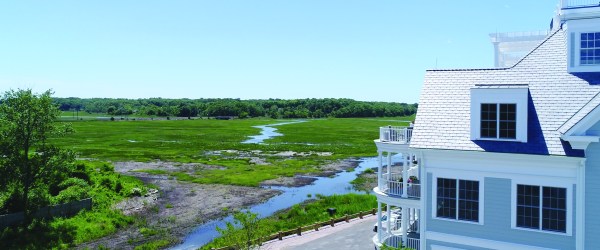
Overlooking the marsh and Long Island Sound, it should not come as a surprise that the property at The Residences at 66 High Street sits within a flood zone. But what does this mean and why is there no reason to worry?

As described by the Federal Emergency Management Agency (FEMA), flood zones vary based on location. At low elevation and in close proximity to the ocean, the site at 66 High Street lies in a Special Flood Hazard Area (SFHA). An SFHA is an area that can become flooded in the event of a 1-percent annual chance flood, also known as a base or 100-year flood. For more details about SFHAs, as well as moderate and minimal flood hazard areas, check out FEMA’s explanation.

See here how the property falls within the base flood zone. All structures comply with FEMA standards. Living spaces have been raised seventeen feet, seven feet above the 100-year floodplain. Raising the first floor of the Whitfield, Leete, and Chittenden buildings allowed us to conveniently place resident parking in the new buildings underground.

As a result of adapting to meet flood management regulations, flood insurance costs are a mere fraction of what they otherwise would have been. In addition to the security systems in place on site, the storm-resilient buildings at 66 High Street can provide residents with a furthered sense of security and peace of mind.

What Does a Real Estate Developer Do? Why?

If you have seen Caddyshack, you may remember Al Czervik. An obnoxious man of ample wealth and few morals, Czervik threatens to buy Bushwood Country Club and convert the land into condominiums. His character and ambitions reinforce a stigma that clouds the way people think about real estate developers and development. While there are bad apples in every industry, few people truly understand what developers do and what their motives are.

What does a real estate developer do?

In short, real estate developers are individuals and companies that are responsible for taking a vision for a site and making it come to fruition. This is easier said than done. Bringing a building project to life involves a great deal of risk, time, patience, and collaboration. The overall process of development may look something like this:

  1. Purchase land or an existing property.
  2. Establish a building program and design.  First, establish a purpose for  the building. Should it be residential? Commercial? Then, collaborate with the architects, planners, engineers, surveyors, inspectors, etc. to establish a design.
  3. Obtain the necessary public approval and financing.
  4. Build.
  5. Rent, Lease or Sell.

What are a developer’s motives?

Al Czervik and unethical real estate developers in the news may lead people to believe that developers are money-hungry and heartless, but these ideas are ill-founded. It is true that if done correctly, real estate development can be highly profitable. However, in order to be successful in the industry, developers must understand that investing wholeheartedly in a project means also investing in future users and the surrounding community. Developers must be motivated by money, as they too need to make ends meet and turn a profit, but the best developers must be equally as motivated by making the world a better, more beautiful place.

At Horton Group, in the acquisition and development of a property, our vision extends beyond property lines. While we are invested in what we do, we are equally as invested in the people and communities we do it for.

Why is Green Space in a Commercial Development Important?

Formerly home to a plant nursery and landscape design company, the 16-acre site of 350 Goose Lane Office Park provides an amazing opportunity to reap the rewards of abundant green space.

Green space is any area of trees, grass, or vegetation, and is especially beneficial in commercial developments. Actions as simple as strategically planting trees can have significant impacts. In urban areas, green rooftops are an option when landscaping space is not available.  According to a report by the Natural Resources Defense Council (NRDC), net benefits of green space include:

  • Higher property values, rental rates, and retail sales
  • Lower energy costs
  • Reduced flood damage and infrastructure costs
  • Improved health and job satisfaction for tenants and employees

In the case of a leased property, developers, landlords, tenants, and employees all benefit. Expense-related benefits are particularly advantageous for tenants in a commercial space like 350 Goose Lane, as the leases offered are triple net, meaning the tenant pays for real estate taxes, building insurance, and maintenance.

Developers must preserve and implement green space wherever and whenever the opportunity is afforded to ensure that a project is economically and environmentally sustainable for all parties involved.

What is Type II-B Construction?

New construction, whether it is for a single family home, small business, or large complex, requires builders and companies to follow strict guidelines to ensure safety for all involved.

Every building is classified as a construction type based on the materials used to build and the fire resistance rating of the materials. The five main types of construction are outlined below:

  • Type I – Fire Resistive
  • Type II – Non-Combustible
  • Type III – Ordinary (Exterior Protected)
  • Type IV – Heavy Timber
  • Type V – Wood Frame

In our ongoing luxury project, The Residences at 66 High Street, we build to fit guidelines of Type II-B construction. Type II-B construction is an uncommon form of construction in Luxury Real Estate condominium developments such as this. The walls and roof are constructed from non-combustible materials, such as masonry, tilt slab, or metal. Weight bearers in Type II-B buildings are typically steel beams.

Type II-B construction is one of the reasons The Residences at 66 High Street has won the Home Builders and Remodelers Association of Connecticut’s distinguished HOBI Awards for:

  • BEST Condominium Community
  • BEST Luxury Condominium Unit
  • BEST Historic Rehab
  • 2016 PROJECT OF THE YEAR

THS_BlogCTA_TypeIIB


Website Built with WordPress.com.

Up ↑